Drain management.
Tank bottom valves and drain-optimized diaphragm bodies with etched alignment marks per size. Welded flange and Tri-Tank styles · ¼" to 4" · 316L bar stock, machined in Carson City.
Tank Bottom Valves
Two styles, designed in collaboration with customers to address vessel-bottom problems other valves cannot solve. Both machined from 316L bar stock, both engineered to leave nothing stagnant at the bottom of a vessel.
Aquasyn's tank bottom valve range was developed through close collaboration with existing customers to meet system-level needs that off-the-shelf valves consistently miss. The original Welded Flange body has been re-engineered into a more compact unit, with the weir face moved closer to the weld flange and the chamber between weir and flange opened to eliminate stagnant fluid at the vessel bottom. The Tri-Tank variant uses a tri-clamp connection for vessels that need stripping and cleaning between batches.
Which style to specify. Both drain at a 30° outlet angle, so the hygienic behavior is the same. The difference is height and removability. Welded Flange is the volume seller: you cut the hole, weld the valve in, and the body sits tight to the vessel. Tri-Tank is specified when the valve has to come off without breaking a weld, which is a smaller share of installations.
Clearance is usually what decides it. The Welded Flange body is roughly ¾" shorter than the equivalent Tri-Tank, and because the Tri-Tank also hangs a clamp below the vessel, the installed saving at the smallest size works out around an inch. That differential scales with the valve: on a 4" body it is closer to three or four inches of drop. On a low-clearance skid or a tank sitting near the floor, that is often the whole decision.
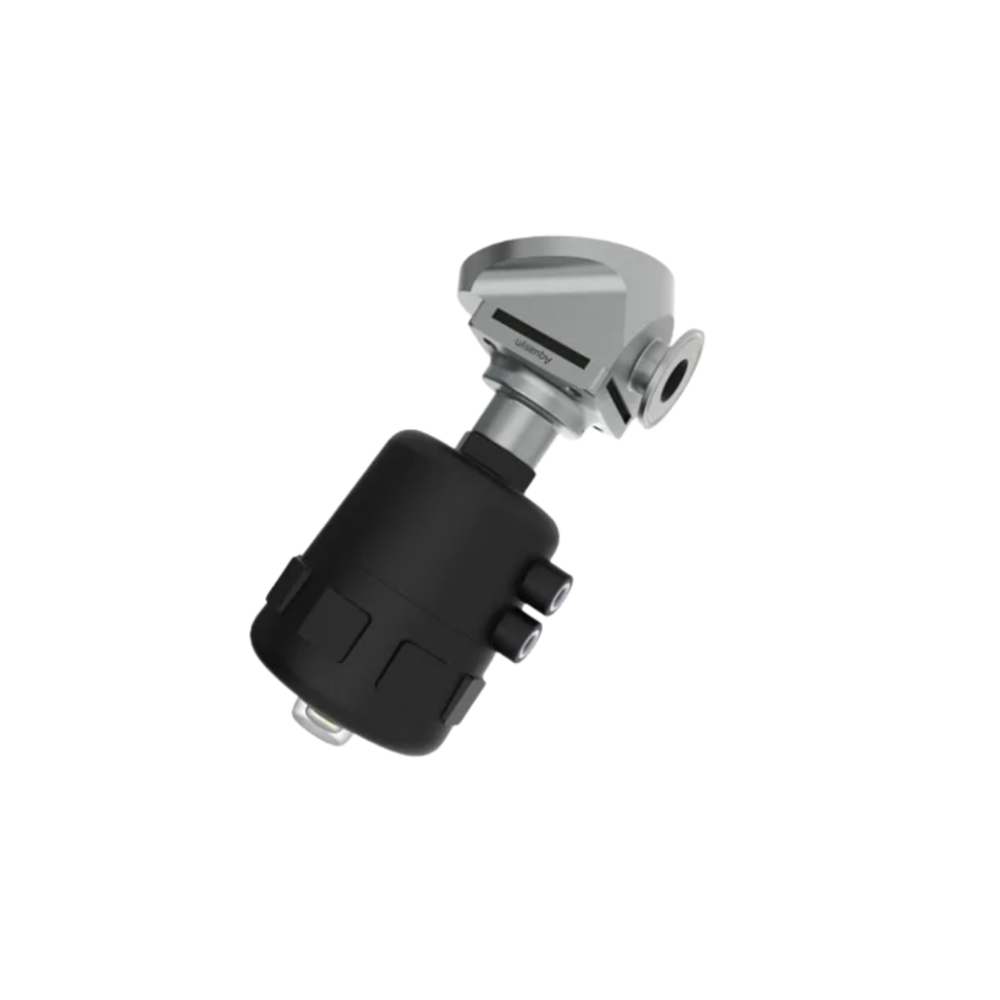

Drain-Optimized Diaphragm Bodies
The same Aquasyn two-way diaphragm valve, configured at the drain point. Etched orientation marks, exterior radiused and sloped exteriors, optimum self-drain angles per size. The body does the work · no separate drain fitting required.
Every Aquasyn two-way diaphragm valve body is geometry-optimized for gravity drainage. The exterior body surfaces are radiused and sloped to promote cleanability by wash-down or COP methods. Drain alignment marks are etched on the end connections so the installer can verify orientation visually rather than measure. Specify a standard two-way at the drain point, and the body's geometry handles drainage as standard · no special order code, no separate fitting, no compromise.
Body geometry
- Radiused and sloped exterior surfaces
- Optimum self-drain angle per nominal size
- Etched drain marks on every end connection
- Bar stock · no castings · no porosity
- Promotes wash-down and COP cleanability
Installation behavior
- No separate drain fitting required
- Visual alignment without measuring
- Drain valves on Multi-Port and Block-Body assemblies follow the same geometry rules
- SAR / SAL / HGV / VGV configurations
- Validated through customer collaboration on real system layouts
Optimum self-drain angles · per nominal size.
The geometric angles at which each Aquasyn diaphragm body achieves complete gravity drainage. Etched marks on every end connection let installers verify orientation visually. Source: Aquasyn 2023 catalog, page 12.
Where Aquasyn drain valves do the work.
Specified across hygienic processes where stagnant fluid at the vessel bottom or the drain point creates an audit, cleaning, or contamination risk.
Tell us where you're draining.
Welded Flange and Tri-Tank styles, ¼" through 4", every standard size shipping from raw stock in Carson City. Custom connection combinations quoted by engineering directly.